
Let’s have a real conversation today.
Lately, our community has been shaken by heartbreaking news. Young, vibrant voices in the cancer space facing aggressive secondary cancers and late-stage diagnoses. When someone who did everything "right" had the surgeries, rang the bell, lived out loud, gets hit with a brand new stage IV diagnosis, it stops all of us in our tracks. It makes you sit up a little straighter and ask: Wait a minute. How does this happen? And what do I need to be doing right now to protect myself?
As someone who survived Stage IV triple-negative breast cancer by letting science, not emotion, dictate my next move, I’m not here to scare you. I’m here to equip you. Because when you Know Your Biology™, you stop waiting for the healthcare system to catch up to you, and you start driving the car.
Whether you are years out from your initial cancer treatment or navigating a brand-new early-onset colorectal or GI cancer diagnosis, here is the blueprint every patient and survivor needs in their back pocket.
1. Survivorship Isn’t "Set It and Forget It": > Screening for Secondary Cancers
Here is something nobody tells you enough when you finish active treatment: surviving one cancer slightly increases your statistical risk of developing a second primary cancer a brand new cancer in a different part of your body, completely unrelated to your first diagnosis.
Why? Sometimes it’s shared genetic predispositions. Sometimes it’s the late effects of life-saving chemo or radiation from years ago. And right now, doctors are seeing an alarming, unexplained rise in early-onset colorectal and gastric cancers in adults under 45.
Ditch the standard screening calendar. Standard guidelines say start colonoscopies at 45. If you are a cancer survivor, standard does not apply to you. Cancer “runs” in my family with multiple people diagnosed before the age of 50. I started my screenings for breast cancer in my 30’s (due to my families history) and continue to stay on high alert and get screened on a regular basis for other kinds of cancer! Ask your doctor if you need baseline colonoscopies, breast MRIs, or skin checks years earlier.
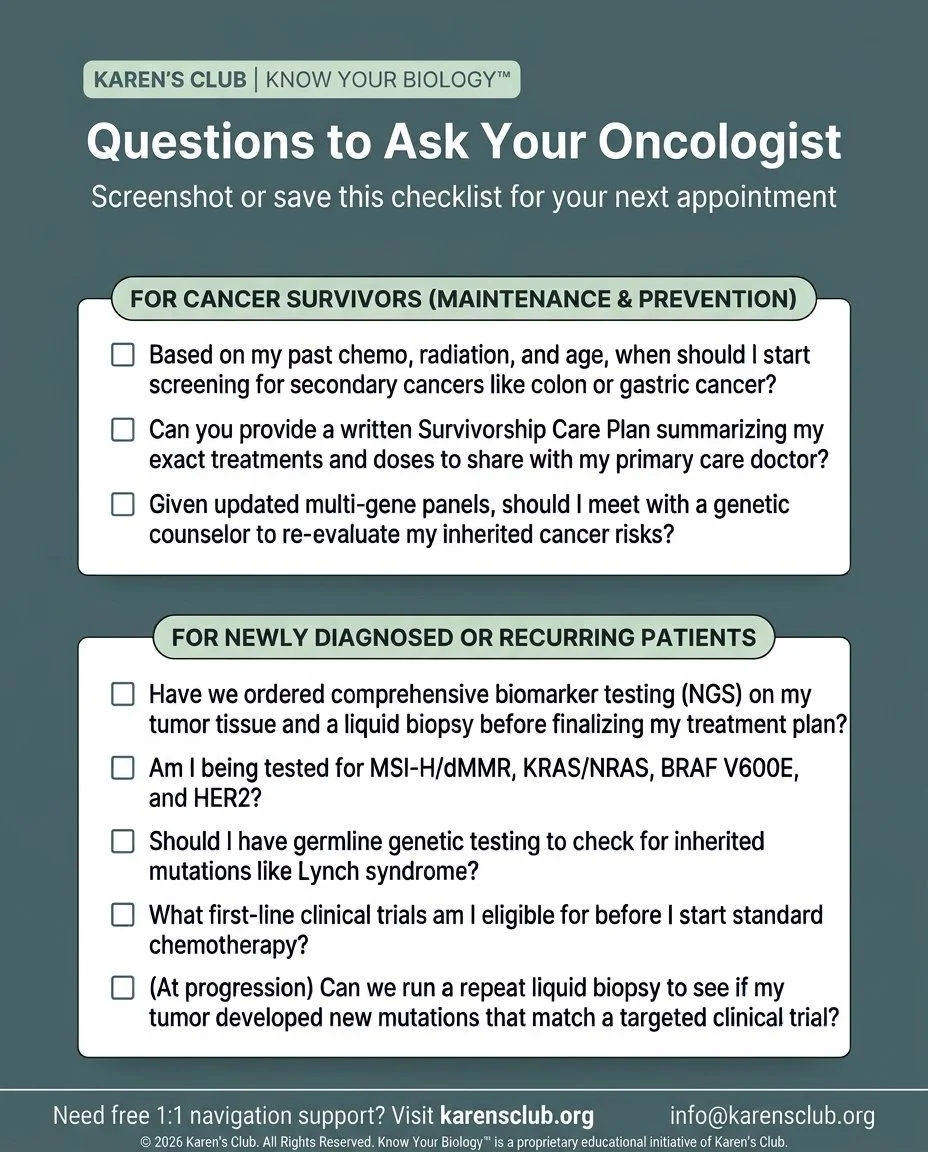
Keep your Survivorship Care Plan handy. Once you transition back to a primary care doctor, they don't always know the exact chemo drugs or radiation fields you received. Bring them a written summary so they know what to watch for. This is especially true if your cancer treatment happened at a different facility, or hospital network.
Never let a symptom get brushed off. We are so used to chalking up fatigue, stomach pain, or bowel changes to "normal post-treatment life." If something feels off for more than two weeks, demand a workup. You know your body better than anyone else. And if you hit a wall with "You're too young" or "Insurance won't pay for that," pull out these four power moves ⬇️
Change the Billing Code ("Diagnostic" vs. "Screening"): Insurance companies often deny a screening colonoscopy or scan if you are under 45. The moment you have a real symptom, like rectal bleeding, unexplained iron deficiency anemia, persistent bloating, or a change in bowel habits, your doctor must order it as a diagnostic test. Diagnostic workups are medically necessary and covered differently regardless of your age.
Use the "Differential Diagnosis" Script: If a doctor brushes off your symptoms because of your age, look them in the eye and say: "I understand cancer is less common at my age, but given my prior cancer history, what is your differential diagnosis, and how are we ruling out a second primary cancer today?"
Make Them Document the Refusal: If a provider still refuses to order a test or referral, calmly say: "Please document in my medical chart today that I requested a diagnostic workup for [symptom] given my cancer history, and that you declined to order it." Doctors rarely want a documented refusal in a high risk patient's chart, and this phrase frequently prompts an immediate order.
Loop Your Oncologist Back In: Primary care doctors don't always know survivorship guidelines. If your PCP pushes back, message your former oncology team or survivorship clinic through your patient portal and ask them to order the diagnostic test or send a letter of medical necessity to your insurance.
2. Biomarker & Genetic Testing: Your Tumor’s Fingerprint
If you or someone you love is diagnosed with early onset Stage IV colon or GI cancer, do not let anyone lock in a treatment plan until comprehensive biomarker and genetic testing are ordered.
Think of it like this: two people can have the exact same Stage IV colon cancer on paper, and two completely different tumors under the microscope. Without testing, doctors are flying blind. You need two types of tests:
Germline (Inherited) Testing: Up to 1 in 4 people diagnosed with colorectal cancer under age 50 carry an inherited gene mutation (like Lynch syndrome, BRCA1/2, PALB2, or CHEK2), even with zero family history. Every patient under 50 should get a blood or saliva multi-gene panel.
Somatic (Tumor) Biomarker Testing: Using tumor tissue or a fast blood-based liquid biopsy, Next Generation Sequencing (NGS) looks for the specific drivers fueling the cancer:
MSI-H / dMMR: The golden ticket for immunotherapy, which can often work better than standard chemo right out of the gate.
RAS (KRAS / NRAS) & BRAF V600E: Tells your team which targeted therapies will actually work and which ones won't waste your precious time.
HER2 & Rare Fusions (NTRK, RET): Unlocks specialized targeted drugs and antibody drug conjugates.
3. Clinical Trials: Why Timing Is Everything ⏰
🗣️Let me say this loud enough for the people in the back: Clinical trials are NOT a last resort.
I don’t tell patients they should join a clinical trial. I tell them they deserve to know whether a clinical trial is an option, and when you ask that question changes everything.
The First-Line Window: Many of the most exciting trials, combining immunotherapy, cancer vaccines, or next-gen targeted drugs, are only open to treatment-naive patients (meaning you haven't started standard chemo yet). Once you take that first infusion without checking trials, you can accidentally lock yourself out of those studies.
Protect Your Strength: Trials have strict eligibility rules around organ function and physical stamina. Looking at trials early, while your body is strong, gives you the highest chance of qualifying. It’s the oxymoron that is sad, but true, researchers want “the healthiest of the sick!”
Use Liquid Biopsies at Progression: Cancer is smart; it mutates to outsmart treatment. If a treatment stops working, ask for a repeat liquid biopsy before switching to the next standard drug. That blood test gives a real-time snapshot of the tumor’s new mutations so you can match to a second or third-line trial targeting that exact change.
📋 Printable Checklist: Questions to Ask Your Oncologist
4. Trusted Resources & Navigation Support
You do not have to figure this out alone. Here are free, patient support organizations ready to help you navigate testing, trials, and financial barriers:
1:1 Clinical Trial & Biomarker Navigation: Karen’s Club – Book a free, personalized 1:1 consultation with a trained patient advocate to understand your pathology, prepare for appointments, and explore clinical trials.
Colorectal Cancer Support & Biomarker Aid: Colorectal Cancer Alliance – Offers free patient navigation, biomarker education, and financial assistance programs for screening and care.
Clinical Trial Matching: Fight Colorectal Cancer (Fight CRC) – Features an easy-to-use clinical trial finder and up-to-date biomarker guides.
Financial Assistance for Care, Testing & Travel: Patient Advocate Foundation (TotalAssist) (copay relief, case management, and insurance navigation) and CancerCare
Have questions about your own screening plan or biomarker report? Reach out to us at info@karensclub.org because knowledge is power, and nobody fights alone.
Hugs.
K
Medical Disclosure: The content of this post is intended purely for educational and motivational purposes. It does not constitute professional medical advice, diagnosis, or treatment. The coordination, planning, and execution of your cancer care plan should always take place under the direct guidance and supervision of a licensed medical professional.
